
AssureCKD Team Spotlight: Dr. Claudio Rigatto, Co-Founder
Behind every effort to improve kidney care are clinicians who have spent years seeing the consequences of late diagnosis firsthand. In this Team Spotlight, Dr. Claudio Rigatto shares his journey through nephrology, research, and innovation, and explains why he believes earlier and more accessible kidney testing has the potential to fundamentally change outcomes for patients living with chronic kidney disease (CKD).
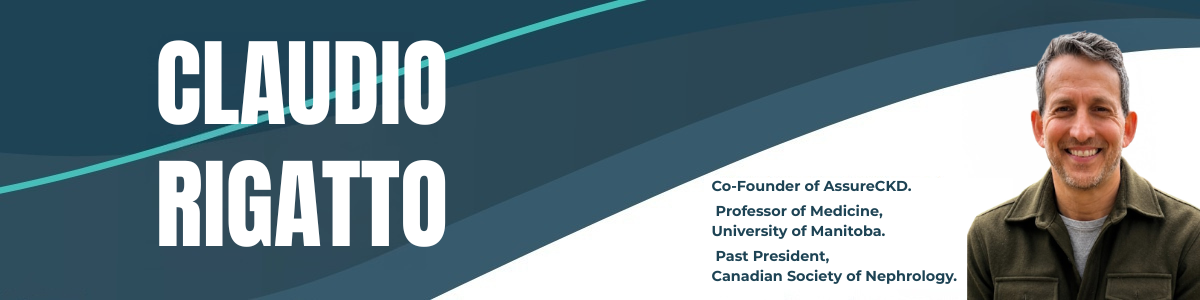
Dr. Claudio Rigatto – MD, FRCPC (Co-Founder)
Dr. Claudio Rigatto is a nephrologist, clinician scientist, Professor of Medicine at the University of Manitoba, and Co-Founder of AssureCKD. Over the course of his career, his work has focused on chronic kidney disease, dialysis, kidney biomarkers, and improving outcomes through earlier detection and intervention. He previously served as President of the Canadian Society of Nephrology and has authored numerous publications related to kidney disease diagnostics, cystatin C, eGFR, and point-of-care technologies.
A Career Focused on Earlier Intervention
“What first drew me to nephrology was the complexity of the biology, but what kept me there was the patients,” Claudio explains.
Throughout his clinical career, he repeatedly saw patients arriving with advanced kidney disease that may have been preventable or delayed through earlier diagnosis and treatment.
“Kidney disease is often silent until very late, and it’s heartbreaking to see patients come in with end-stage kidney failure from a process that could potentially have been identified earlier.”
Over time, that experience shaped not only his clinical practice, but also his research interests. His work increasingly focused on improving kidney disease screening, biomarkers, and diagnostic accessibility.
Bridging Clinical Care and Diagnostic Innovation
In addition to his clinical work, Claudio has spent years contributing to research focused on kidney biomarkers, microfluidics, and decentralized diagnostic technologies. Much of this work centered around improving access to kidney testing and making diagnostics more practical, scalable, and accessible outside centralized laboratories.
That long-term research direction eventually helped shape the vision behind AssureCKD and MATLOC.
“We reached a point where the clinical evidence around cystatin C was advancing faster than the healthcare workflow itself,” Claudio says. “In many places, samples still need to be packaged, shipped to reference labs, and processed days later. That gap between clinical need and diagnostic accessibility was one of the motivations behind AssureCKD.”
From his perspective, one of the major challenges in CKD care today is not simply the science itself, but the disconnect between clinical need and real-world workflow limitations.
Why Cystatin C Matters
Claudio believes cystatin C represents an important advancement in kidney care because it can provide a more accurate assessment of kidney function in many patient populations where creatinine alone may be misleading.
“Cystatin C gives us a more accurate picture of kidney function in patients where creatinine can be affected by age, muscle mass, frailty, or chronic illness,” he explains. “It improves risk stratification, helps refine eGFR estimates, and is increasingly being incorporated into clinical guidelines and medication decision-making.”
As newer CKD guidelines continue emphasizing dual-marker approaches and more accurate kidney assessment, Claudio sees cystatin C becoming increasingly important in routine clinical practice.
Building MATLOC Around Real Clinical Workflows
According to Claudio, virtually every aspect of MATLOC has been shaped by real-world clinical experience.
“We designed MATLOC around the idea that kidney testing should be fast, practical, and available during the patient encounter, not days later after multiple disconnected steps,” he says.
Rather than focusing only on the technology itself, the goal was to solve a broader operational and clinical problem: improving access to high-quality kidney testing while reducing delays, workflow friction, and barriers to adoption.
This focus on workflow practicality became especially important after hearing recurring feedback from labs and healthcare organizations that cystatin C testing often remains a send-out assay associated with additional turnaround time, operational complexity, and reimbursement challenges.
The Value of Multidisciplinary Collaboration
One of the most rewarding parts of building AssureCKD, Claudio says, has been working within a multidisciplinary team that combines medicine, engineering, science, and commercialization.
“Clinicians define the problem, engineers develop solutions, scientists validate them, and commercialization experts help translate them into something scalable and impactful,” he says. “When that collaboration works well, innovation moves much faster.”
That combination of perspectives has helped shape MATLOC into more than simply a diagnostic platform. It has also helped align the technology with practical implementation realities across healthcare settings.
Looking Ahead
Looking forward, Claudio hopes MATLOC can help shift kidney care toward earlier detection, earlier treatment, and ultimately better patient outcomes.
“If we can make kidney testing more accessible in primary care and community settings, we have an opportunity to identify high-risk patients sooner, reduce progression to kidney failure, and improve how CKD is managed at a population level.”
For Claudio, the long-term vision is straightforward: making accurate kidney assessment more accessible, more practical, and more integrated into everyday healthcare workflows.
You can learn more about Claudio and AssureCKD by following us on LinkedIn!
